


In southern Sweden, the city of Lund has built a multi-story parking garage that clearly shows how people can reuse old materials in practical and creative ways. The project demonstrates that builders can integrate wind turbine parts, which they usually treat as waste, into everyday structures.
Located in the fast-growing Brunnshög district, an area known for science, innovation, and modern urban design, the car park stands out not for its size or capacity but for its design. Its outer walls use retired wind turbine blades instead of metal panels or plain concrete, turning an environmental challenge into a visible and easy-to-understand solution.
A parking garage built from retired wind turbine blades in Sweden
The Niels Bohr car park uses 57 wind turbine blades that once produced clean electricity in Denmark. These blades came from a wind farm that had reached the end of its working life. Normally, people cut up and bury these blades because recycling them is very difficult. In this project, workers carefully transported them to Sweden and gave them a new role.
The blades form large outer panels on the building. These panels act like a “curtain wall.” This means they do not carry the building’s weight, but they wrap around it and protect it from wind and rain. From a distance, the long white shapes are easy to spot. Up close, visitors can see that the building uses materials that once generated renewable energy.
🧱 Finland builds world’s largest sand battery — and it’s heating homes without oil or pollution
The garage has five to six main levels, described locally as 13 half-levels. This design makes it easier for cars to move up and down smoothly. Inside, the garage holds around 300 vehicles, depending on how planners count the spaces. Designers set aside some areas for short visits and others for longer parking needs.
The structure is owned and run by the city’s parking authority. It is one of several car parks in Lund, but it stands out because of its unusual design and strong environmental message. Instead of hiding recycled materials, the building puts them on display.
Turning a recycling problem into visible urban design
Wind turbine blades are built to last. They face strong winds, storms, sunlight, and cold for decades. To survive these conditions, they are made from tough materials like fiberglass and carbon-fiber composites. While these materials are strong and light, they are also very hard to break down once the blades are no longer in use.
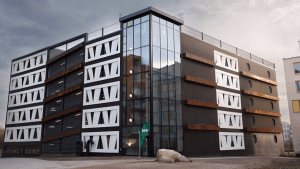
The Lund parking garage shows another way. Instead of trying to break the blades into smaller pieces, the project keeps them mostly intact. Their shape and strength become an advantage rather than a problem. By using them as façade panels, the building avoids the need for new materials while also solving part of the blade disposal issue.
Hottest Month, Highest Costs: How Climate Extremes in July 2025 Shook the Global Economy
The white surface of the blades reflects light and gives the garage a clean and modern look. Plants and greenery are added between sections of the façade. These plants are chosen to support insects like bees and butterflies. This adds a small but important biodiversity feature to a structure that would normally be just concrete and steel.
This approach also helps people understand recycling better. Instead of reading about waste problems in reports, residents and visitors can see the solution in front of them. Every time someone parks a car, they interact with a building that tells a story about reuse and resource efficiency.
Clean energy features and everyday benefits for the neighborhood
The parking garage in Sweden is not only about reused materials. It also supports cleaner transport in daily life. Inside, there are 40 charging points for electric vehicles. This makes it easier for people to choose cars that produce less pollution, especially in a growing district designed around sustainability.
Solar panels cover the roof and generate electricity for the building and its charging stations. When they produce more energy than the garage needs at a given moment, a battery system stores the extra power. This setup ensures that the building uses all locally generated electricity without wasting it.
Experts warn of AI-powered influence operation after fake Polexit videos flood Polish TikTok
The design fits well into the Brunnshög area, which is home to research centers, housing, and public spaces. The garage supports visitors, workers, and residents without taking up extra land for parking. By building upward instead of outward, the city saves space for parks, homes, and walking paths.
The use of wind turbine blades also reduces the demand for new construction materials. Producing concrete, steel, and aluminum usually creates high carbon emissions. By reusing existing materials, the project lowers its environmental footprint, even though it is still a large concrete structure at its core.
The garage has drawn attention from planners and designers beyond Sweden. It shows that large, hard-to-recycle parts do not always need complex technology to be reused. Sometimes, a change in thinking is enough. By seeing waste as a resource, cities can reduce landfill use and create buildings that spark curiosity and discussion.
This parking garage does not rely on futuristic ideas or distant promises. It exists today, serving cars, charging electric vehicles, and standing as a clear example of circular design. Old wind turbine blades, once seen as a disposal problem, now shape the face of a public building in one of Sweden’s most innovative urban districts.