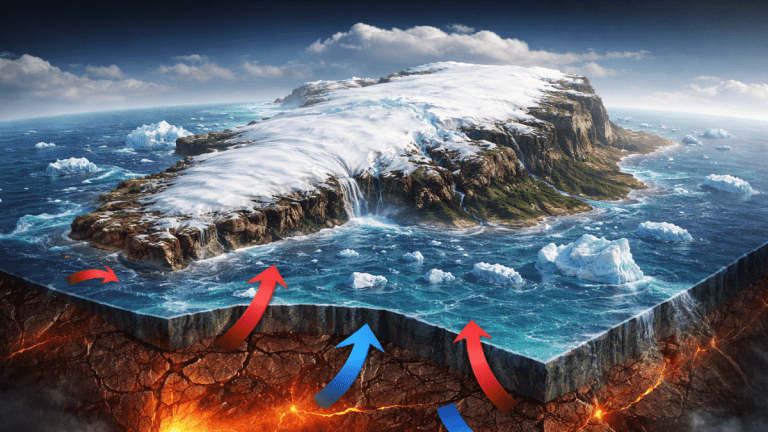
Greenland Is Not As Still As It Looks
Greenland sits on a massive piece of Earth’s crust called the North American tectonic plate. Tectonic plates are huge slabs of rock that move very slowly over millions of years. This movement helps shape mountains, oceans, and continents. While plate motion plays a role in Greenland’s position, it is not the main reason behind the recent changes scientists are seeing.
What makes Greenland special is the enormous amount of ice covering it. Thick ice sheets press down on the land below with incredible force. For thousands of years, this weight has pushed the bedrock downward, keeping it compressed and stable.
As global temperatures rise, large parts of Greenland’s ice are melting. When ice melts, it does not just raise sea levels. It also removes weight from the land underneath. With less pressure pressing down, the bedrock begins to respond. This response is slow but powerful.
The ground beneath Greenland is lifting and shifting as it adjusts to the loss of ice. This process is known as land rebound. It is similar to how a sponge slowly rises back up after something heavy is removed from it. The Earth’s crust behaves in a similar way, though over much longer periods of time.
Using advanced measurements and long-term data, scientists have been able to track these movements with great accuracy. They looked at changes stretching back tens of thousands of years and combined that information with very precise modern measurements. This approach allowed them to see how Greenland has been moving over long periods and how it is moving right now.
Stretching, Shrinking, and Slow Movement
One of the most surprising findings is that Greenland is not simply expanding as the ice melts. Instead, it is stretching in some directions and being pulled inward in others. This creates a strange effect where the island becomes slightly smaller overall, even though parts of it are spreading apart.
In some areas, the land is moving outward at a rate of about two centimeters per year. This may sound tiny, but over many years it adds up. At the same time, other regions are moving toward each other. These opposing movements cause Greenland to change shape in complex ways.
This stretching and shrinking happen because Earth’s crust does not move evenly. When pressure from ice is removed, some areas rise faster than others. The land reacts based on its structure, depth, and the forces acting beneath it. The result is a mix of expansion and contraction across the island.
These changes are not caused by earthquakes or sudden events. They happen quietly and steadily. People living in Greenland would not feel the movement happening beneath them. Only highly sensitive instruments can detect these shifts.
The important point is that Greenland’s movement is not just about drifting with tectonic plates. Climate change is now playing a direct role by speeding up ice loss. As more ice melts, the pressure on the land keeps changing, and so does the way the ground responds.
Why These Changes Matter in the Arctic
The Arctic region is warming faster than most other parts of the world. This rapid warming affects ice, oceans, wildlife, and land. Greenland sits at the center of many of these changes, making it a key area for scientific observation.
By closely monitoring how Greenland’s landmass shifts, scientists gain a clearer picture of how Earth responds to climate-driven changes. The movement of the ground can affect sea levels, coastlines, and even how water flows beneath glaciers.
Understanding these processes also helps improve models used to track ice melt and land movement. Better models mean more accurate measurements of how the Earth is changing in response to rising temperatures.
Greenland’s slow reshaping shows that climate change is not only altering weather patterns and ice cover. It is also interacting with deep geological systems that have been at work for millions of years. These systems respond gradually, but once they begin changing, they can continue for a very long time.
The data collected from Greenland highlights the close connection between surface conditions, like melting ice, and the hidden layers of Earth below. It shows that the planet works as one connected system, where changes in one area can affect many others.
Greenland may look the same on a map today, but beneath the surface, it is slowly shifting, stretching, and shrinking. This quiet transformation is a powerful reminder that Earth is always moving, even when it seems still.