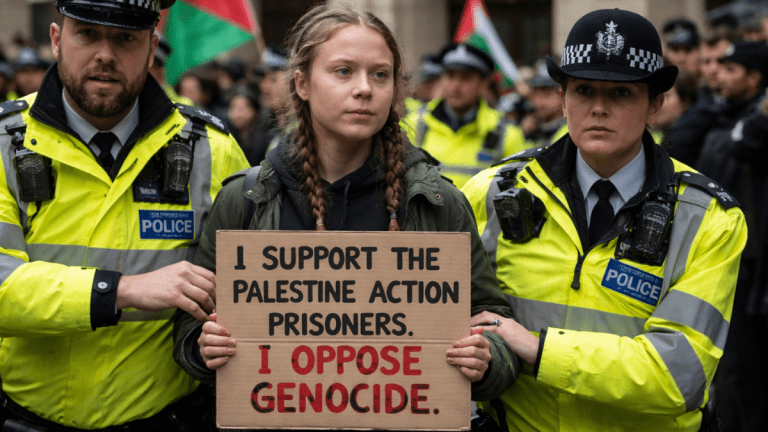
Swedish climate activist Greta Thunberg was released from custody after police arrested her in London during a pro-Palestinian protest. The arrest immediately drew attention in the UK and abroad because it involved terrorism-related laws and a well-known public figure. Police later confirmed that Thunberg was released on bail and must comply with legal conditions until March.
The incident took place on Tuesday in the City of London. Authorities said they acted following reports of protest-related offenses near a commercial building. As details emerged, the case quickly became part of a wider public discussion about protest laws, freedom of expression, and how governments respond to demonstrations linked to international conflicts.
Arrests during the London demonstration
The protest unfolded near a building in central London that campaigners said had links to companies operating in the defense sector. Earlier in the day, police arrested two people for allegedly throwing red paint at the building. Officers said the act caused damage and prompted an immediate response.
Later, Greta Thunberg arrived at the same location. Police said she displayed a placard that expressed support for Palestine Action prisoners and opposed genocide. The British government has formally banned Palestine Action by classifying it as a terrorist organization. Under UK law, publicly supporting or promoting a banned group is a criminal offense.
As a result, police arrested Thunberg under the Terrorism Act. Campaigners confirmed that officers took her into custody and questioned her. Police later released her on bail, which means she can remain free while legal proceedings continue.
City of London Police stated that Thunberg would remain on bail until March. At the time of her release, authorities did not confirm whether formal charges had been filed. However, they emphasized that the investigation was ongoing.
Meanwhile, the campaign group Prisoners for Palestine explained that the protest focused on a building used by an insurance company. According to the group, the firm provides services to the British arm of an Israeli defense company. The activists said they targeted the location to draw attention to corporate involvement in the conflict.
The insurance company did not immediately respond to requests for comment. Police also clarified that they made arrests based on observed actions and existing laws, not on personal views or political opinions.
Police action and protest laws in the UK
UK police explained that they acted under counter-terrorism legislation designed to prevent support for banned organizations. The Home Office has the authority to outlaw groups it considers a security threat. Once banned, any form of public support, including signs or slogans, can lead to arrest.
In recent years, the UK has strengthened its protest and public order laws. As a result, police now have broader powers to intervene during demonstrations, especially when protests link to criminal damage, national security, or banned groups. Authorities say these measures help maintain public safety and uphold the law.
However, critics argue that such laws can limit free expression. They say arrests like this one raise concerns about how far protest rights extend in a democratic society. Supporters of strict enforcement respond by saying that the law applies equally to everyone, regardless of fame or influence.
This was not Greta Thunberg’s first encounter with UK police. Last year, officers arrested her during a London protest focused on climate issues. However, a judge later cleared her of any offense, ruling that police did not have the legal authority to arrest her at that time.
The current arrest differs because it involves terrorism-related legislation rather than public order offenses. Legal experts note that this distinction makes the case more serious and complex.
Police stressed that their actions focused on the content of the placard and the legal status of the group mentioned. They also said that ongoing investigations would determine the next steps.
Broader activism of Greta Thunberg
Greta Thunberg first gained global attention in 2018 when she began protesting outside the Swedish parliament to demand action on climate change. Her solo protest soon inspired millions of students worldwide to join climate strikes. Over time, she became one of the most recognizable youth activists of her generation.
As her platform grew, Thunberg began speaking on a wider range of issues. In addition to climate change, she addressed social justice, human rights, and global conflicts. Supporters say her activism reflects a belief that environmental and humanitarian issues are closely connected.
In October, Thunberg joined the Global Sumud Flotilla, a convoy of activist vessels attempting to deliver aid to Gaza. Israeli authorities detained her along with hundreds of others and later expelled them from the country. Israeli officials have repeatedly denied allegations of genocide linked to the conflict.
The London arrest adds another chapter to Thunberg’s activism beyond climate protests. While her supporters describe her actions as peaceful and symbolic, authorities continue to emphasize that all individuals must follow the law during demonstrations.
At 22 years old, Thunberg remains a powerful voice for many young people worldwide. Her arrest and release in London once again placed international focus on the limits of protest, the use of counter-terrorism laws, and the balance between free expression and national security.
For now, Thunberg remains free on bail as the legal process continues. Police have not shared further details about potential court proceedings. However, the incident has already sparked strong reactions and renewed debate about protest rights in the UK and beyond.