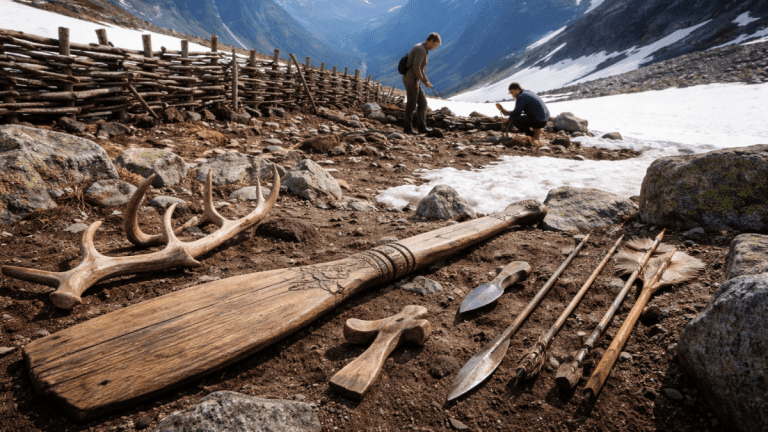
High in the icy mountains of western Norway, melting snow and ice have uncovered a surprising secret from the distant past. Archaeologists working in the Aurlandsfjellet mountain area have revealed a 1,500-year-old reindeer trapping site that remained hidden for centuries. The discovery shows how people once survived in harsh mountain landscapes long before roads, cars, and tourism transformed the region.
The site lies around 4,600 feet above sea level, in a place that today attracts travelers for its scenic views and dramatic mountain roads. However, long ago, this same landscape served a very different purpose. It functioned as an important hunting ground where people trapped and processed reindeer, an animal vital for food, clothing, and tools.
As the ice retreated, it exposed wooden structures, hunting tools, and animal remains in unusually good condition. The findings offer a rare look into everyday life during a time when people depended directly on nature to survive.
A hidden hunting system preserved by ice
Archaeologists uncovered the site after carefully excavating the frozen ground during summer fieldwork. They found hundreds of tree branches stacked together to form two long wooden barriers. These barriers stretch across the mountain terrain and appear to guide reindeer into a narrow space.
Experts believe hunters used this setup as a trapping system. The wooden walls likely funneled reindeer into a controlled area, where hunters could capture or kill them more easily. This method reduced risk and increased success, especially in a high-altitude environment where weather conditions could change quickly.
The preservation of the wood surprised researchers. Normally, organic materials like branches rot over time. However, snow and ice sealed the structures soon after people stopped using them. As a result, the cold acted like a natural freezer, protecting the site for more than a thousand years.
Near the wooden barriers, archaeologists also found large numbers of reindeer antlers. Many of them show clear-cut marks. These marks suggest that hunters slaughtered and processed the animals on-site. This detail helps confirm that the location served as more than just a trap. It also functioned as a working area where people prepared meat and materials.
The repeated use of the structures over time indicates that the site played an important role in seasonal hunting activities. Hunters likely returned year after year until changing conditions forced them to abandon it.
Ancient tools and a mysterious wooden oar
Alongside the trapping structures, archaeologists recovered several hunting tools. These include iron spearheads, wooden arrows, and three bows. All of these items point clearly to reindeer hunting and reflect the technology available at the time.
Smaller objects also emerged from the ice in Norway. Among them was a finely crafted antler brooch shaped like a tiny axe. This piece may have fastened clothing and could have been lost during a hunt. Its detailed design shows care and skill, even in objects used for everyday life.
Another antler item served as a clothing pin. Like the brooch, it highlights how people used animal parts not only for food but also for personal items. Such finds rarely survive in ordinary archaeological digs, making this discovery especially valuable.
One object, however, stands out as a mystery. Archaeologists found a carved wooden boat oar made from pine wood. The oar appears decorative and carefully shaped. Its presence high in the mountains raises many questions.
🌍 Climate collapse ahead? Norway’s $1.6 trillion fund warns of 19% U.S. portfolio loss
Today, people associate oars with water, not snow-covered peaks. Yet this oar lay preserved far above any river or lake. Archaeologists do not yet know why it ended up there. It could have served a symbolic purpose, belonged to a traveler, or been repurposed in a way no longer obvious.
Because the oar remained frozen for centuries, it survived almost intact. This level of preservation allows scientists to study tool-making methods and wood selection in great detail. Further analysis may help explain how and why such an object reached this remote location.
Climate and history frozen together in the mountains of Norway
The exceptional condition of the site connects closely to changes in climate during the past. Experts believe a period of colder weather in the mid-sixth century played a key role. Lower temperatures likely brought heavier snowfall and expanding ice across the mountains.
As snow and ice built up, hunters may have found the area harder to access. Over time, they stopped using the trap. Soon after, thick layers of snow and ice covered the wooden structures, antlers, and tools. This natural covering protected the site from decay and human disturbance.
For centuries, the mountain landscape remained quiet and frozen. Only now, as global temperatures rise, does the ice retreat enough to reveal what lies beneath. The melting ice has turned the mountains into unexpected archives of human history.
Similar discoveries have appeared in other parts of Norway in recent years. Melting glaciers have revealed ancient wooden skis, leather footwear, and other everyday objects lost long ago. Each find adds another piece to the story of how people adapted to cold environments.
At Aurlandsfjellet, the discovery also changes how people view the landscape. What looks like untouched wilderness today once supported organized hunting and skilled craftsmanship. The mountains served as working spaces, shaped by human hands and knowledge.
The exposed site shows how closely people once lived with nature. They understood animal behavior, weather patterns, and terrain. They built structures using local materials and relied on them for survival. As ice continues to melt, more hidden sites may emerge from high mountains in Norway. Each one holds silent evidence of human life preserved by cold, now slowly returning to view.